There was no official word on the outcome of the talks.

In its annual threat assessment presented before the Senate Armed Services Committee during a Congressional hearing on Tuesday, the US intelligence community said the expanded military posture by both India and China along the disputed border elevates the risk of armed confrontation between the two nuclear powers that might involve direct threats to US persons and interests and calls for America's intervention.

The Chinese military on Friday confirmed that the troops of China and India have begun the process of disengagement from the Patrolling Point 15 in the Gogra-Hotsprings area of eastern Ladakh in a 'coordinated and planned way'.
A joint statement released on Thursday said both sides exchanged views in an 'open and constructive' manner to resolve the 'relevant issues' and that it was agreed to maintain 'security and stability' on the ground in the region.

Chief of Army Staff Gen Manoj Pande has carried out a comprehensive review of India's military preparedness along the Line of Actual Control (LAC) in Arunachal Pradesh in his first visit to the border state after last month's clash between Indian and Chinese forces in the Tawang sector.

On Monday China said it has "effectively managed and controlled" frictions in certain border areas.
The border standoff between the Indian and Chinese militaries erupted on May 5 last year following a violent clash in the Pangong lake area and both sides gradually enhanced their deployment by rushing in tens of thousands of soldiers as well as heavy weaponry.

Gen Pande also said that Indian troops are adequately deployed along the Line of Actual Control to deal with any situation and that guidance has been given to them to "remain firm and resolute" in their tasks.
India and China are likely to hold the 16th round of high-level military talks on July 17 to resolve the issues in remaining friction points along the Line of Actual Control (LAC) in eastern Ladakh, people familiar with the development said on Wednesday.

The fresh round of Corps Commander-level talks took place at the Chushul-Moldo border point on the Chinese side of the Line of Actual Control in eastern Ladakh, they said.

The sources said the soldier was handed back to China at the Chushul-Moldo border point in eastern Ladakh at 10.10 am.
India and China to hold the 11th round of corps commander-level talks at Chushul in eastern Ladakh at 10.30 am on Friday that is expected to focus on disengagement of troops in remaining friction points, sources within the Indian Army said.

Vice Chief of Army Staff Lieutenant General C P Mohanty on Thursday carried out a comprehensive review of India's military preparedness in eastern Ladakh on the first day of his three-day visit to the region where Indian and Chinese troops have been locked in a bitter standoff for over a year.
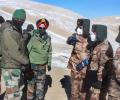
Indian Army Chief General M M Naravane had said on Wednesday that India was hopeful of resolving issues related to disengagement at Patrolling Point 15 (Hot Springs) in eastern Ladakh in the 14th round of talks.
India and China failed to make any breakthrough, but agreed to maintain dialogue to arrive at a mutually acceptable resolution at the earliest.

This is Gen Pande's first visit to the sector after taking over as the chief of the Indian Army on April 30.
"China creeps towards hegemony in Asia, threatens India's borders, and treats other countries as junior partners, Indian-American Congressman Ro Khanna said.

The situation along the Line of Actual Control (LAC)in eastern Ladakh remained 'very fragile' and is 'quite dangerous' in military assessment because of close deployments of troops of both sides in some pockets though substantial progress has been made in the disengagement process in many areas, External Affairs Minister S Jaishankar said on Saturday.

The Army said Gen Pande witnessed Parvat Prahar exercise besides interacting with officers and troops deployed in the region. The exercise featured a display of operational capabilities by artillery guns and other key weapon systems.

The transgression took place on August 30, and the Chinese troops returned from the area after spending few hours, they said.
The development comes after after reaching a consensus in the 16th round of military talks, the two sides said in a joint statement this evening.
The MEA said there has not been any change in India's position on the LAC and the mutual redeployment as a result of the disengagement process should not be misrepresented.

China plans to build a new highway along the Line of Actual Control (LAC) with India as part of Beijing's efforts to strengthen its strategic position and project its power, a media report said on Wednesday.
'The two sides should support rather than undermine each other, strengthen cooperation rather than guard against each other, and enhance mutual trust rather than be suspicious of each other'
The Working Mechanism for Consultation and Coordination on India-China Border Affairs (WMCC) was established in 2012 as an institutional mechanism for consultation and coordination for the maintenance of peace and tranquillity in the border areas.

The Indian Army has deployed a significant number of easily transportable M-777 ultra-light howitzers in mountainous regions along the Line of Actual Control (LAC) in Arunachal Pradesh, military officials said on Thursday.

India is looking forward to a "constructive" dialogue with China to resolve issues in remaining friction points in eastern Ladakh, sources in the security establishment said on Monday ahead of the 14th round of military talks between the two sides on the 20-month row.
....a long-term boundary agreement is reached between the two countries.

China on Tuesday announced that its Defence Minister General Li Shangfu will visit India this week to attend the meeting of SCO defence ministers from April 27 during which he is expected to hold talks with his Indian counterpart Rajnath Singh on ending the prolonged eastern Ladakh standoff which has severely strained bilateral ties.

The Army said it was also highlighted that completion of disengagement in other areas would pave the way for the two sides to consider de-escalation of forces and ensure full restoration of peace and tranquillity and enable progress in bilateral relations.
There was no comment from the Indian side on the statement made by the Chinese defence ministry spokesperson Colonel Wu Qian, and carried by China's official media.

The NSA particularly highlighted the need for resolving outstanding issues as quickly as possible and talked about the need for maturity and sincerity in dealing with the issue.

India and China held a special round of military talks on Tuesday at the Chushul-Moldo border meeting point in Eastern Ladakh to discuss air space violations and provocations by the Chinese side in that area in the last 45 days.

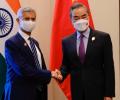
The discussions took place on the sidelines of the G20 Foreign Ministers' Meeting.
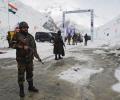
External affairs ministry spokesperson Arindam Bagchi said it is essential that "appropriate agreements between India and China of 1993 and 1996 are scrupulously followed".

After India firmly told China that its violation of the border pacts has "eroded" the entire basis of bilateral ties, China's defence ministry on Friday said the situation at the border is "generally stable" and both sides should put the boundary issue in an "appropriate position" and promote its transition to "normalised management".
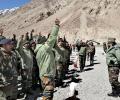
On development of infrastructure by China in border areas, the Army chief said it is going on unabated.
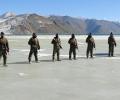
A day after the nearly 12-and-half-hour talks, the two sides, in a joint statement on Monday, reaffirmed that the resolution of the pending issues would help in the restoration of peace and tranquility along the Line of Actual Control (LAC) in the region and enable progress in bilateral relations.

The destabilising and corrosive behaviour of the Chinese Community Party in the Indo-Pacific region is simply not helpful and some of the defence infrastructure that is being set up by China near its border with India is alarming, US Army's Pacific Commanding General Charles A Flynn said on Wednesday.
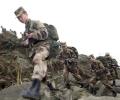
The Indian Army has been slow to react. Indian troops have deployed in the vicinity of PLA incursions, but there are no attempts to outflank Chinese positions.
